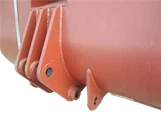
Hey there! I'm a supplier of 3 - Cubic Meter Buckets, and today I wanna talk about something that might seem a bit technical but is super important: the thickness of the walls of these buckets.
First off, let's understand why the wall thickness matters. A 3 - Cubic Meter Bucket is used in a bunch of different industries, like construction, mining, and agriculture. In these tough environments, the bucket has to deal with all sorts of abuse. Whether it's scooping up heavy rocks, digging into hard soil, or moving large volumes of materials, the bucket needs to be strong enough to withstand the pressure and the wear and tear.
So, what's the ideal wall thickness for a 3 - Cubic Meter Bucket? Well, it ain't a one - size - fits - all answer. There are a few factors that come into play.
Material Quality
The type of material used to make the bucket is a huge deal. High - quality steel alloys are commonly used because they offer a great balance of strength and durability. For example, some buckets are made from AR400 or AR500 steel. AR stands for Abrasion Resistant, and the numbers indicate the hardness of the steel. The harder the steel, the more resistant it is to wear.


If you're using a high - quality steel like AR500, you might be able to get away with a slightly thinner wall thickness compared to a lower - quality steel. A bucket made from AR500 steel could have a wall thickness of around 10 - 12 millimeters and still perform really well. On the other hand, if you're using a less - durable steel, you might need to go up to 15 - 20 millimeters to ensure the bucket lasts.
Usage Conditions
The way the bucket is going to be used also affects the wall thickness. In a mining operation, where the bucket is constantly dealing with sharp rocks and heavy loads, a thicker wall is usually necessary. The rocks can cause a lot of abrasion and impact damage, so a wall thickness of 18 - 25 millimeters might be required.
In a construction site where the materials are a bit softer, like sand or gravel, a thinner wall could work. Maybe around 10 - 15 millimeters would be sufficient. And in an agricultural setting, where the bucket is mainly used for moving hay or manure, an even thinner wall, say 8 - 12 millimeters, could be okay.
Design and Reinforcement
The design of the bucket can also play a role in determining the wall thickness. Some buckets have additional reinforcement features like ribs or gussets. These can help distribute the stress more evenly across the bucket, allowing for a thinner wall in some areas.
For instance, if a bucket has well - placed ribs on the sides, it can handle the load better, and the wall thickness can be reduced slightly. However, it's important to make sure that the reinforcement is done properly. If the ribs are too thin or not welded correctly, they won't provide much extra strength.
Now, let's talk about how the wall thickness affects the performance of the bucket. A thicker wall generally means a stronger bucket. It can handle more abuse without getting damaged. But there's a trade - off. A thicker wall also means a heavier bucket.
A heavier bucket can put more strain on the equipment that's using it. For example, if you're using a loader to operate the bucket, a very heavy bucket can make the loader work harder, which can lead to increased fuel consumption and more wear on the loader's components.
On the other hand, a thinner wall can make the bucket lighter, which is good for fuel efficiency and reducing wear on the equipment. But if the wall is too thin, the bucket might not be strong enough and could break or wear out quickly.
As a 3 - Cubic Meter Bucket supplier, I've seen all sorts of situations. We offer buckets with different wall thicknesses to meet the needs of our customers. If you're in the mining industry, we can provide you with a bucket with a thick wall that can handle the tough conditions. Check out our High Quality Mining Scraper Parts 6 Cubic Bucket for an idea of the heavy - duty options we have.
For construction and agricultural customers, we have buckets with thinner walls that are more lightweight and cost - effective. Our 2 - cubic Meter Bucket is a great example of a bucket that's suitable for these less - demanding applications. And if you need a support frame for a smaller bucket, take a look at our 1 - cubic Meter Side Support Frame.
In conclusion, the thickness of the walls of a 3 - Cubic Meter Bucket depends on a variety of factors. There's no single right answer, but by considering the material quality, usage conditions, and design, you can choose the right wall thickness for your needs.
If you're in the market for a 3 - Cubic Meter Bucket or any of our other products, we're here to help. We can work with you to figure out the best wall thickness and design for your specific application. Don't hesitate to reach out to us for more information or to start a purchase negotiation. We're committed to providing high - quality products at competitive prices.
References
- Machinery's Handbook, 31st Edition
- Steel Construction Manual, 15th Edition