When it comes to the world of construction, mining, and various heavy - duty industries, buckets are indispensable tools. Among the different types of buckets available, the 1 - Cubic Meter Bucket stands out, and it's essential to understand how it differs from a regular bucket. As a supplier of 1 - Cubic Meter Buckets, I'm excited to share some in - depth insights on this topic.
Capacity
The most obvious difference between a 1 - Cubic Meter Bucket and a regular bucket lies in their capacity. A regular bucket can come in a wide range of sizes, but generally, they are much smaller than a 1 - Cubic Meter Bucket. Regular buckets might have capacities ranging from a few liters to perhaps 0.5 cubic meters in some larger non - standard cases.
A 1 - Cubic Meter Bucket, as the name suggests, has a volume of one cubic meter. This large capacity allows it to carry a significantly larger amount of material in a single scoop. For example, in a construction site where large quantities of sand, gravel, or soil need to be moved, a 1 - Cubic Meter Bucket can make the job much more efficient. Instead of making multiple trips with a smaller regular bucket, workers can use the 1 - Cubic Meter Bucket to move a large amount of material at once, reducing the overall time and effort required for the task.
Applications
The capacity difference also leads to different applications for these two types of buckets. Regular buckets are often used for smaller - scale tasks. In gardening or landscaping, a small regular bucket might be used to carry soil for planting individual flowers or shrubs. In a workshop, it could be used to collect small parts or debris.
On the other hand, 1 - Cubic Meter Buckets are designed for heavy - duty and large - scale applications. In mining operations, they are used to scoop up large amounts of ore or overburden. In large - scale construction projects such as building highways or skyscrapers, these buckets are used to move massive quantities of construction materials. They are also commonly used in large - scale earth - moving projects, where large volumes of soil need to be excavated and relocated.
Structural Design
The structural design of a 1 - Cubic Meter Bucket is more robust compared to a regular bucket. Due to its large capacity, it needs to withstand greater forces when filled with heavy materials. The walls of a 1 - Cubic Meter Bucket are usually thicker and made of high - strength steel to prevent deformation or breakage.
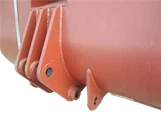
The attachment points of a 1 - Cubic Meter Bucket to the machinery (such as an excavator or a loader) are also designed to handle the increased weight and stress. These attachment points are often larger and more reinforced to ensure a secure connection. In contrast, regular buckets, which carry less weight, can have a more lightweight and less - reinforced design.
Compatibility with Machinery
1 - Cubic Meter Buckets require more powerful machinery to operate effectively. Since they are larger and heavier when filled, they need an excavator or loader with sufficient lifting capacity and power. For example, a small - sized excavator might not be able to handle a 1 - Cubic Meter Bucket properly, as it may not have the strength to lift and maneuver the filled bucket.
Regular buckets, on the other hand, can be used with a wider range of machinery, including smaller and less - powerful equipment. This makes them more versatile in terms of the machinery they can be attached to, but they are also limited in the amount of work they can perform due to their smaller capacity.


Cost
The cost of a 1 - Cubic Meter Bucket is generally higher than that of a regular bucket. This is due to several factors. Firstly, the larger size and the use of high - strength materials in its construction increase the manufacturing cost. Secondly, the need for more powerful machinery to operate it also adds to the overall cost, as the user needs to invest in or rent a suitable machine.
Regular buckets, being smaller and less complex in design, are usually more affordable. They are a cost - effective option for small - scale operations or tasks where a large capacity is not required.
Product Range and Variations
As a 1 - Cubic Meter Bucket supplier, we offer a variety of options to meet different customer needs. For example, we have the 1 - cubic Meter Bucket, which is a standard design suitable for general earth - moving and material - handling tasks. We also provide the 1 - cubic Meter Side Dump Bucket, which is useful in situations where the material needs to be dumped to the side, such as in narrow construction sites or when working near obstacles.
In addition, if you need an even larger capacity, we also have the 3 - cubic Meter Bucket, which is suitable for extremely large - scale projects.
Conclusion
In conclusion, the differences between a 1 - Cubic Meter Bucket and a regular bucket are significant in terms of capacity, applications, structural design, compatibility with machinery, and cost. While regular buckets are suitable for small - scale and light - duty tasks, 1 - Cubic Meter Buckets are the go - to option for large - scale, heavy - duty operations.
If you're involved in a project that requires moving large volumes of materials, a 1 - Cubic Meter Bucket can greatly enhance the efficiency and productivity of your work. As a supplier, we are committed to providing high - quality 1 - Cubic Meter Buckets that meet the highest industry standards. Whether you're in the construction, mining, or any other relevant industry, we can offer the right bucket solution for your needs.
If you're interested in learning more about our 1 - Cubic Meter Buckets or would like to discuss your specific requirements, please don't hesitate to reach out. We're here to help you make the best choice for your project.
References
- Construction Equipment Handbook, various editions
- Mining Engineering Textbooks on Material Handling Equipment
- Industry reports on the use of buckets in different sectors