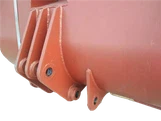
Hey there! I'm a supplier of the 3 - Cubic Meter Boom, and today I want to chat about its data transmission system for remote monitoring. It's a pretty cool topic, and understanding it can give you a better grasp of how this piece of equipment works and why it's so useful.
First off, let's talk about what a 3 - Cubic Meter Boom is. If you're curious, you can check out the details here: 3-cubic Meter Boom. This boom is a key part of many industrial operations, especially in construction and mining. It's designed to handle a significant volume of material, making it a workhorse in the field.
Now, onto the data transmission system. Remote monitoring is all about getting real - time information from the boom without being physically present. This is super important because it allows operators to keep an eye on the equipment's performance, detect any potential issues early, and make informed decisions quickly.
The data transmission system of a 3 - Cubic Meter Boom typically consists of several components. At the heart of it are the sensors. These sensors are placed all over the boom to measure different parameters. For example, there are sensors to measure the boom's position, the load it's carrying, the pressure in the hydraulic systems, and the temperature of various parts.
The position sensors are crucial. They use technologies like GPS or inertial measurement units (IMUs). GPS gives an accurate location of the boom in the global coordinate system, which is great for tracking its movement across a large work site. IMUs, on the other hand, can measure the boom's orientation, such as its tilt and rotation. This information is essential for ensuring that the boom is operating within safe limits and that it's being used efficiently.
Load sensors are another important part. They can tell us how much weight the boom is handling at any given time. Overloading the boom can lead to serious damage and safety risks. By constantly monitoring the load, operators can avoid these problems and keep the equipment in good working condition.
Hydraulic pressure sensors are used to monitor the pressure in the hydraulic cylinders that control the movement of the boom. Hydraulic systems are a vital part of the boom's operation, and any drop or spike in pressure can indicate a problem, such as a leak or a malfunctioning valve. Temperature sensors, meanwhile, keep an eye on the heat generated by the equipment. Excessive heat can cause components to wear out faster or even fail, so it's important to keep the temperature in check.
Once the sensors collect all this data, it needs to be transmitted to a central monitoring station. This is where the communication part of the data transmission system comes in. There are several ways to do this, and the choice often depends on the location and the requirements of the work site.
One common method is wireless communication. Wi - Fi can be used if the boom is operating in an area with a stable Wi - Fi network. It's a fast and reliable way to transmit data, but its range is limited. For larger work sites, cellular networks are a better option. Most modern 3 - Cubic Meter Booms are equipped with cellular modems that can connect to 3G, 4G, or even 5G networks. This allows the data to be sent over long distances, and operators can access it from anywhere in the world as long as they have an internet connection.
Satellite communication is another option, especially for remote work sites where there is no cellular coverage. It provides global coverage, but it can be more expensive and may have a higher latency compared to cellular or Wi - Fi.
When the data reaches the central monitoring station, it's processed and analyzed. Specialized software is used to display the data in an easy - to - understand format, such as graphs and charts. Operators can then review the data, look for trends, and identify any potential problems. For example, if the load sensor shows a sudden increase in weight, it could mean that the boom is being overloaded. Or if the hydraulic pressure sensor shows a drop in pressure, it could indicate a leak.


Now, let's compare the 3 - Cubic Meter Boom with some other similar products. If you're interested in a more compact option, you might want to check out the 2-cubic Meter Rear Operator's Cabin Swing Arm. It has a smaller capacity but may be more suitable for certain applications where space is limited. And for a fixed - type boom, the Fixed Crusher Boom is a great choice. It's designed for specific crushing operations and has its own unique data transmission and monitoring requirements.
In conclusion, the data transmission system of a 3 - Cubic Meter Boom is a complex but essential part of its operation. It enables remote monitoring, which improves safety, efficiency, and maintenance. If you're in the market for a 3 - Cubic Meter Boom or any of our other products, we'd love to have a chat with you. Whether you have questions about the data transmission system or want to discuss your specific needs, don't hesitate to reach out. We're here to help you make the best choice for your business.
References
- General knowledge about industrial equipment sensors and data transmission technologies
So, come on and let's start a conversation about your equipment needs!