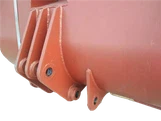
In the heavy - duty construction, mining, and industrial sectors, the efficiency, durability, and shock resistance of equipment are of paramount importance. Our company, as a prominent supplier of 3 - Cubic Meter Buckets, constantly receives inquiries about the shock - resistant capabilities of our product. Today, let's delve into this topic to provide a detailed understanding for all our potential clients.
Understanding the Concept of Shock Resistance in Buckets
Before we specifically discuss the 3 - Cubic Meter Bucket, it's essential to understand what shock resistance means in the context of buckets used in industrial applications. Shock resistance refers to the ability of a bucket to withstand sudden, intense forces without suffering significant damage. In construction and mining operations, buckets may encounter various shock - inducing situations, such as hitting large rocks, sudden stops during excavation, or collisions with other hard - surfaced objects.
A bucket with high shock resistance can maintain its structural integrity, which not only reduces the need for frequent repairs and replacements but also ensures continuous and efficient operation. This can significantly cut down on downtime and associated costs for businesses.
Factors Affecting the Shock Resistance of 3 - Cubic Meter Buckets
Material Selection
The choice of material is a fundamental factor in determining the shock - resistant properties of a 3 - Cubic Meter Bucket. At our company, we use high - strength alloy steels that are specifically engineered to resist high - impact forces. These alloys have a unique combination of hardness and toughness, which allows the bucket to absorb shock without cracking or deforming easily.
Hardness is crucial for resisting wear and abrasion under normal operating conditions, while toughness enables the bucket to deform plastically when subjected to shock, dissipating the energy through the material rather than causing brittle failure. Our in - house material experts carefully select the appropriate steel grades based on the specific requirements of different applications.
Design Geometry
The design of the 3 - Cubic Meter Bucket also plays a significant role in its shock resistance. A well - designed bucket distributes the shock forces evenly across its structure. For example, the shape of the bucket's edges and corners can influence how the forces are transferred. Rounded edges and smooth transitions are often preferred as they help to reduce stress concentrations.
Moreover, the internal reinforcement structures, such as ribs and braces, are strategically placed to enhance the overall rigidity of the bucket. These reinforcements add additional strength to critical areas that are more likely to experience high - impact forces, allowing the bucket to better withstand sudden shocks.
Manufacturing Processes
The manufacturing processes used to produce our 3 - Cubic Meter Buckets can greatly affect their shock - resistant capabilities. Precision welding techniques are employed to ensure strong and reliable joints between different parts of the bucket. Welding is a critical step in bucket manufacturing, as weak welds can become points of failure under shock loading.
Heat treatment is another important process. By subjecting the bucket components to controlled heating and cooling cycles, we can optimize the material's mechanical properties, such as hardness and toughness. This heat treatment process further enhances the bucket's ability to resist shock.


Comparing with Smaller Capacity Buckets
To better understand the shock - resistant performance of our 3 - Cubic Meter Bucket, it can be helpful to compare it with smaller capacity buckets, such as the 1 - cubic Meter Bucket and the 2 - cubic Meter Bucket.
Smaller capacity buckets generally have less mass and are typically used for lighter - duty applications. While they may also be designed to resist shock, the 3 - Cubic Meter Bucket is built to handle more substantial loads and more severe working conditions. Its larger size and greater mass provide more surface area and material to absorb and distribute shock forces.
For instance, in a mining operation where large rocks need to be loaded, a 3 - Cubic Meter Bucket can grip and handle heavier loads compared to smaller buckets. The increased mass and robust design enable it to withstand the greater impact forces generated when picking up and dropping large rocks.
Real - World Applications and Case Studies
Let's look at some real - world applications where the shock - resistant properties of our 3 - Cubic Meter Buckets are put to the test. In an open - pit mining operation, the buckets are used to load large quantities of ore into trucks. The ore often consists of hard rocks, and the process of scooping and dumping these rocks generates significant shock forces.
One of our clients reported that after replacing their old buckets with our 3 - Cubic Meter Buckets, they noticed a substantial reduction in breakdowns due to shock - related damages. The buckets were able to withstand the continuous impact of loading and unloading the heavy ore, resulting in increased productivity and reduced maintenance costs.
In a large - scale construction project, the 3 - Cubic Meter Buckets were used for earthmoving and excavation work. The buckets had to deal with sudden encounters with buried rocks and uneven ground surfaces. Our shock - resistant buckets performed admirably, maintaining their structural integrity even after repeated shocks. This allowed the project to progress smoothly without unexpected delays caused by equipment failure.
Testing and Quality Assurance
We are committed to providing the highest - quality 3 - Cubic Meter Buckets with excellent shock - resistant properties. To ensure this, we conduct a series of rigorous tests on our products.
One of the key tests is the impact test, where the bucket is struck with a controlled force using a large hammer or a specialized impact testing machine. The energy of the impact is carefully measured, and the bucket is inspected for any signs of damage, such as cracks or excessive deformation.
We also perform finite element analysis (FEA) during the design phase. FEA is a computer - based simulation technique that can predict how the bucket will respond to different types of forces, including shock. By analyzing the stress and strain distribution within the bucket structure, we can optimize the design to improve its shock resistance.
Our Product Range and Customization
In addition to the standard 3 - Cubic Meter Bucket, we also offer a wide range of related products to meet different customer needs. For example, our Large Scraper Rock Bucket For Industrial Usage With Wear - Resistant Design (Custom Specifications Support) is designed for more demanding applications where wear resistance is also a critical factor.
We understand that every customer's requirements are unique, so we offer customization services. Whether you need a bucket with a special shape, different material specifications, or additional features, our experienced engineering team can work with you to develop a personalized solution. This ensures that you get a 3 - Cubic Meter Bucket that is perfectly tailored to your specific application and can provide the best shock - resistant performance.
Conclusion and Call to Action
In conclusion, our 3 - Cubic Meter Buckets are designed and manufactured to offer excellent shock - resistant capabilities. Through careful material selection, advanced design, and strict quality control, we ensure that our buckets can withstand the toughest working conditions in the construction, mining, and industrial sectors.
If you are looking for a reliable and shock - resistant 3 - Cubic Meter Bucket for your business, we invite you to reach out to us for further discussions. Our team of experts is ready to assist you in choosing the right product and provide detailed information on our customization options. Contact us today to start your journey towards more efficient and durable equipment solutions.
References
- "Materials Science and Engineering: An Introduction"by William D. Callister, Jr. and David G. Rethwisch.
- "Heavy Equipment Handbook" by Karl W. Smith.