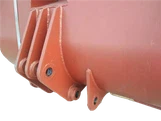
Hey there! I'm a supplier of 1 - Cubic Meter Buckets, and today I wanna talk about how to measure the weight of the contents in a 1 - Cubic Meter Bucket. It might sound like a simple question, but there's actually quite a bit to it.
First off, let's understand why measuring the weight of the stuff in a 1 - Cubic Meter Bucket is important. Whether you're in construction, mining, or any industry that uses these buckets, knowing the weight helps you manage your loads better. Overloading a bucket can lead to all sorts of problems, like equipment damage, safety hazards, and inefficiencies.
So, how do we go about measuring this weight? There are a few different methods, and I'll break them down for you.
Method 1: Using Density
The most straightforward way is to use the density of the material in the bucket. Density is defined as mass per unit volume. The formula for density is (ρ=\frac{m}{V}), where (ρ) is density, (m) is mass (which is what we want to find), and (V) is volume.


We know the volume of our bucket is 1 cubic meter ((V = 1m^{3})). So, if we know the density of the material, we can calculate the mass. For example, if the material is water, the density of water is approximately (1000 kg/m^{3}). Using the formula (m = ρV), we get (m=1000 kg/m^{3}\times1m^{3}=1000 kg).
But what if the material isn't water? Well, different materials have different densities. For instance, the density of sand can vary from about (1442 kg/m^{3}) to (1602 kg/m^{3}), depending on factors like moisture content and grain size. So, if you're dealing with sand, you'd need to find out the specific density of the sand you're using and then plug it into the formula.
If you're in the mining industry, you might be dealing with ores. The density of different ores can vary widely. For example, iron ore has a density that can range from (4800 kg/m^{3}) to (5300 kg/m^{3}). So, measuring the weight of iron ore in a 1 - Cubic Meter Bucket would involve using the appropriate density value.
Method 2: Direct Weighing
Another way to measure the weight of the contents in a 1 - Cubic Meter Bucket is to weigh it directly. You can use a large - scale weighing system. Some industrial scales are designed to handle heavy loads and can accurately measure the weight of a full bucket.
First, you need to weigh the empty bucket. Let's say the empty bucket weighs (W_{empty}). Then, fill the bucket with the material and weigh the bucket again. Let this weight be (W_{full}). The weight of the contents ((W_{contents})) is then (W_{contents}=W_{full}-W_{empty}).
This method is more accurate than using density in some cases, especially when the material has an inconsistent density. For example, if you're dealing with a mixture of different materials, it can be difficult to determine the overall density. Direct weighing takes all these factors into account.
Method 3: Estimation Based on Sampling
If you can't weigh the entire contents of the bucket or don't know the exact density, you can use a sampling method. Take a small sample of the material from the bucket. Weigh the sample and measure its volume. Calculate the density of the sample using the formula (ρ=\frac{m}{V}).
Assume that the density of the sample is representative of the density of the entire contents of the bucket. Then, use this density value in the formula (m = ρV) to estimate the weight of the contents in the 1 - Cubic Meter Bucket.
However, this method has some limitations. The sample might not be fully representative of the entire material in the bucket. For example, if the material has a non - uniform distribution, the density of the sample could be different from the density of the rest of the material.
Now, let me tell you a bit about our 1 - Cubic Meter Buckets. We offer high - quality buckets that are designed to handle a variety of materials. Whether you're using them for construction, mining, or any other application, our buckets are built to last.
If you're in the market for other sizes of buckets, we also have options available. Check out our 7 Cubic Meters Scooptram Bucket High Quality Underground Mining Machinery Parts and High Quality Mining Scraper Parts 6 Cubic Bucket. And of course, don't forget our 1 - cubic Meter Side Dump Bucket.
If you're interested in purchasing our buckets or have any questions about measuring the weight of the contents, feel free to reach out. We're here to help you make the right choice for your needs.
In conclusion, measuring the weight of the contents in a 1 - Cubic Meter Bucket can be done in several ways. Using density is a quick and easy method if you know the density of the material. Direct weighing is more accurate, especially for inconsistent materials. And sampling can be a good option when other methods aren't feasible.
So, if you're looking for a reliable 1 - Cubic Meter Bucket supplier, we're the ones to go to. Contact us for more information and let's start a great business relationship!
References
- "Engineering Handbook of Materials"
- "Mining Engineering Principles"