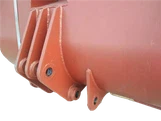
Hey there! As a supplier of 1 - Cubic Meter Buckets, I often get asked about how to measure the volume of these buckets accurately. It's a crucial aspect, whether you're using the bucket for construction, mining, or any other application. So, let's dive right in and explore the different methods to achieve an accurate volume measurement.
Why Accurate Volume Measurement Matters
First off, why is it so important to measure the volume of a 1 - Cubic Meter Bucket accurately? Well, in industries like construction and mining, the amount of material a bucket can hold directly impacts productivity and cost - efficiency. If you over - estimate the volume, you might end up under - loading trucks, which means more trips and higher fuel costs. On the other hand, under - estimating could lead to over - loading, which is not only dangerous but can also damage equipment.
Method 1: Using Water Displacement
One of the most straightforward ways to measure the volume of a bucket is through water displacement. This method is based on Archimedes' principle, which states that the volume of an object submerged in a fluid is equal to the volume of the fluid displaced.
Here's how you can do it:
- Find a large container that can fully submerge the 1 - Cubic Meter Bucket. It could be a big tank or a large pit.
- Fill the container with water up to a marked level. Make sure to measure the initial volume of water in the container. You can use a measuring stick or a calibrated gauge for this.
- Carefully lower the bucket into the water, making sure it's completely submerged. The water level in the container will rise.
- Measure the new water level. The difference between the initial and final water levels is equal to the volume of the bucket.
However, there are a few things to keep in mind. First, the container should be large enough so that the bucket can be fully submerged without overflowing. Also, make sure there are no air bubbles trapped inside the bucket, as this can affect the accuracy of the measurement.
Method 2: Geometric Calculation
If the bucket has a regular shape, like a cylinder or a rectangular prism, you can use geometric formulas to calculate its volume.
Cylindrical Bucket
For a cylindrical bucket, the volume formula is (V=\pi r^{2}h), where (r) is the radius of the base of the bucket and (h) is the height.
- Measure the radius of the base of the bucket. You can do this by measuring the diameter and then dividing it by 2.
- Measure the height of the bucket from the bottom to the top.
- Plug these values into the formula and calculate the volume.
Rectangular Prism Bucket
If the bucket is a rectangular prism, the volume formula is (V = l\times w\times h), where (l) is the length, (w) is the width, and (h) is the height.
- Measure the length, width, and height of the bucket using a measuring tape.
- Multiply these three values together to get the volume.
But in real - world scenarios, buckets often have irregular shapes, which makes geometric calculation a bit tricky. In such cases, you might need to break the bucket down into smaller, regular - shaped sections and calculate the volume of each section separately, then sum them up.
Method 3: Using a Calibrated Measuring Device
There are specialized measuring devices available in the market that can directly measure the volume of a bucket. These devices use advanced sensors and technology to provide accurate measurements.
For example, some devices use ultrasonic sensors to measure the distance from the top of the bucket to the material inside. By knowing the shape of the bucket, the device can calculate the volume based on these distance measurements.
However, these devices can be quite expensive, and you need to make sure they are calibrated correctly before use.


Factors Affecting Measurement Accuracy
There are several factors that can affect the accuracy of volume measurement.
- Bucket Shape: As mentioned earlier, irregularly shaped buckets are more difficult to measure accurately. Any dents, bulges, or non - standard curves can lead to errors in geometric calculations or water displacement measurements.
- Measurement Tools: The accuracy of your measuring tools also plays a significant role. A cheap, low - quality measuring tape might not give accurate length measurements, which can affect the volume calculation.
- Human Error: Incorrect reading of measurements, improper handling of the bucket during measurement, or not following the measurement procedure correctly can all lead to inaccurate results.
Our 1 - Cubic Meter Buckets
At our company, we take pride in providing high - quality 1 - Cubic Meter Buckets. Our buckets are made from durable materials that can withstand the harsh conditions of construction and mining sites. We ensure that the actual volume of our buckets is as close as possible to the stated 1 - Cubic Meter.
If you're in the market for a 1 - Cubic Meter Bucket, or if you're interested in other bucket sizes, we've got you covered. Check out our High Quality Mining Scraper Parts 6 Cubic Bucket and 7 Cubic Meters Scooptram Bucket High Quality Underground Mining Machinery Parts. We also offer the 1.5 - cubic Meter Bucket for those who need a different capacity.
Conclusion
Measuring the volume of a 1 - Cubic Meter Bucket accurately is essential for efficient and safe operations in various industries. Whether you choose the water displacement method, geometric calculation, or a calibrated measuring device, make sure to consider the factors that can affect accuracy.
If you have any questions about our 1 - Cubic Meter Buckets or need more information on volume measurement, feel free to reach out. We're here to help you make the right choice for your needs. Contact us today to start the procurement process and discuss how our buckets can benefit your projects.
References
- Halliday, D., Resnick, R., & Walker, J. (2014). Fundamentals of Physics. Wiley.
- ASTM International. (2019). Standard practices for measuring and reporting the volume of liquid petroleum and petroleum products.