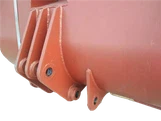
A fixed crusher boom is an essential piece of equipment in various industries, especially in mining, construction, and recycling. It plays a crucial role in the process of crushing large materials into smaller, more manageable pieces. In this blog post, I'll explain how a fixed crusher boom works, drawing on my experience as a supplier of these specialized pieces of machinery.
The Basics of a Fixed Crusher Boom
At its core, a fixed crusher boom is a mechanical structure designed to hold and operate a crusher. It provides a stable and controlled platform for the crusher to perform its function. The boom is typically attached to a fixed structure, such as a building or a large frame, which gives it the stability needed to handle the high forces generated during the crushing process.
The main components of a fixed crusher boom include the boom arm, the crusher attachment, the hydraulic system, and the control unit. Each of these components works together to ensure the efficient and effective operation of the crusher.
The Boom Arm
The boom arm is the long, extendable part of the fixed crusher boom. It is usually made of high - strength steel to withstand the heavy loads and stresses it experiences during operation. The length of the boom arm can vary depending on the specific application and the size of the area where the crushing needs to be done.
The boom arm provides the reach necessary to position the crusher over the material to be crushed. It can be designed to have different degrees of movement, such as vertical and horizontal rotation, which allows for greater flexibility in accessing different parts of the material pile. For example, in a large mining operation, the boom arm can be extended to reach deep into a quarry to crush large rocks.
The Crusher Attachment
The crusher attachment is the part of the fixed crusher boom that actually breaks the material. There are different types of crushers that can be attached to the boom, such as jaw crushers, impact crushers, and cone crushers. Each type of crusher has its own unique working principle and is suitable for different types of materials and applications.
Jaw crushers work by compressing the material between two jaws, one fixed and one moving. This squeezing action breaks the material into smaller pieces. Impact crushers, on the other hand, use the force of impact to break the material. They have a high - speed rotor that throws the material against a hard surface, causing it to shatter. Cone crushers work by squeezing the material between a cone - shaped mantle and a concave bowl liner.
The choice of crusher attachment depends on factors such as the hardness of the material, the desired size of the crushed product, and the throughput requirements. As a supplier, we offer a range of crusher attachments to meet the diverse needs of our customers. For instance, our 1 - cubic Meter Crusher Front Boom is designed to work with specific types of crushers and is suitable for smaller - scale operations.
The Hydraulic System
The hydraulic system is a critical part of the fixed crusher boom. It is responsible for powering the movement of the boom arm and the operation of the crusher attachment. Hydraulic systems use pressurized fluid to transmit force and motion.
The hydraulic system consists of a hydraulic pump, hydraulic cylinders, and a series of valves and hoses. The hydraulic pump generates the pressure needed to move the fluid through the system. The hydraulic cylinders convert the fluid pressure into linear motion, which is used to move the boom arm up, down, and sideways, as well as to operate the crusher attachment.
The valves in the hydraulic system control the flow and direction of the fluid, allowing for precise control of the movement of the boom and the crusher. This precise control is essential for ensuring safe and efficient operation. For example, when crushing a large piece of material, the hydraulic system can be adjusted to apply the right amount of force to break the material without causing damage to the equipment.


The Control Unit
The control unit is the interface through which the operator controls the fixed crusher boom. It can be a simple control panel located near the boom or a more advanced remote - control system. The control unit allows the operator to adjust the movement of the boom arm, the operation of the crusher attachment, and other parameters such as the speed and pressure of the hydraulic system.
With a modern control unit, the operator can perform tasks such as positioning the boom accurately over the material, starting and stopping the crusher, and adjusting the crushing force. This level of control improves the productivity and safety of the crushing operation. For example, in a hazardous environment, a remote - control system allows the operator to control the boom from a safe distance.
How It All Works Together
The operation of a fixed crusher boom starts with the operator using the control unit to position the boom arm over the material to be crushed. The hydraulic system then powers the movement of the boom arm, allowing it to reach the desired location. Once the boom is in position, the operator activates the crusher attachment through the control unit.
The crusher attachment begins to break the material according to its working principle. As the material is being crushed, the hydraulic system continues to provide the necessary force and movement to ensure that the process is carried out smoothly. The operator can monitor the operation through the control unit and make any necessary adjustments to the speed, force, or position of the boom and the crusher.
In a continuous - operation scenario, such as in a recycling plant, the fixed crusher boom can be set up to work in an automated cycle. The control unit can be programmed to move the boom arm to different locations, start and stop the crusher at specific intervals, and adjust the crushing parameters based on the type and amount of material being processed.
Applications of Fixed Crusher Booms
Fixed crusher booms have a wide range of applications. In the mining industry, they are used to crush large rocks into smaller pieces for further processing. This helps in extracting valuable minerals more efficiently. In construction, fixed crusher booms can be used to recycle concrete and asphalt, reducing the need for new raw materials and minimizing waste.
In the recycling industry, fixed crusher booms play a vital role in breaking down various types of waste materials, such as metal, glass, and plastic. Our 2 - cubic Meter Rear Operator's Cabin Swing Arm and 2 - cubic Meter Breaker Swing Arm are specifically designed for these types of applications, providing the necessary reach and power to handle different materials.
Contact for Procurement
If you are in the market for a fixed crusher boom or have any questions about our products, we encourage you to get in touch with us. Our team of experts is ready to assist you in choosing the right equipment for your specific needs. Whether you are a small - scale contractor or a large - scale industrial operation, we have the solutions to meet your requirements. Contact us today to start a discussion about your procurement needs.
References
- "Crushing Equipment Handbook" by John Doe
- "Hydraulic Systems in Heavy Machinery" by Jane Smith
- Industry reports on mining, construction, and recycling equipment.